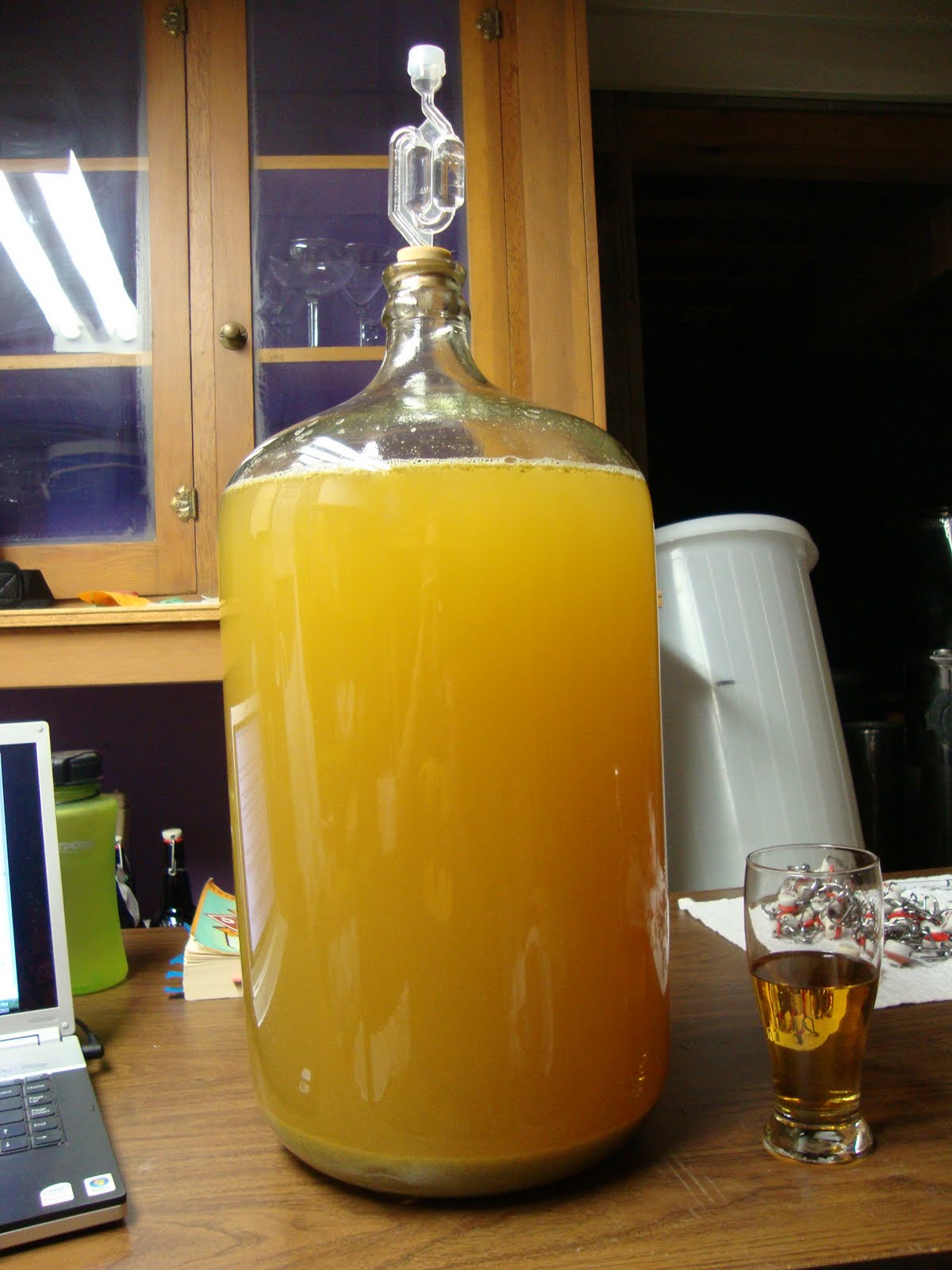
As mentioned in the previous post, I had prepared a chocolate porter for the first time in my brewing history. I was very pleased with the results and will definitely be using chocolate in future batches and in different combinations. After a success one tends to try and keep going on that path. The past two weeks have seen three different batches brewed using first time ingredients largely from the produce and herbal sections at
Organic Planet.
As owner/brewmaster of
Dogfishhead Brewery Sam Calagione would say, 'why brew normal beer?' Although he is both older and wiser in the craft, sometimes you also want to make sure you are brewing what people generally refer to as beer, so that you can be reminded that when it comes down to it, you
can make a style as intended. So this latest activity in the brewery has produced one creative weizen, one daring schwarzbier and one good old fashion brown ale.
These homebrew concoctions were labeled in the J to L spectrum of the alphabet so in keeping with problematizing linear progression, lets start with L:
 Lowbush Vice
- Creative
Made as a hopeful attempt at an untroubled segue from winter to spring; this weiss batch utilized a couple tubs of wheat malt that had been kicking around the brewery for far too long. Lowbush berries - referring to the height of the organic blueberry shrub - were added after a standard boil and allowed to steep for 30 minutes. The longer the steeping lasts the more aromatics the blueberries will produce. Weiss style guidelines call for slight fruity characters in the nose and estery notes in the aroma.
Whe

n using fruit such as this in your beer, it is important to prevent the skins from breaking and keeping all amounts of pectin out of the wort. Mind you, the inside of the blueberry is where the flavor is, but if making a mead or fruit wine you would then need to uncomplicate the yeast's job by chemically stabilizing the amount of acids present, and that is far too much chemistry work for this first shot at blueberry beer.
I'm not sure if the originator of this recipe (which I tweaked from
homebrew favorites) threw out the blueberries after steeping or not, but it would be ridiculous if they did. These are freakin good blueberries still...having said that I now have a couple bags of frozen blueberries that smell like syrup and are covered in hops so choose wisely how you reuse these.
All in all, this Vice has received good reviews from those who have tried it in the tap room. The remaining 2 gallons are bottle conditioning till that beckoning sunny spring day.
 Licorice Lager
-Daring
Unfortunately there are no pictures of this foray into schwarzbier other than one of the secret ingredient in question = Licorice Root.
This batch sums up the creative nature of homebrewing for me. I found a recipe for a dark lager, added licorice root shavings in the last 12 minutes of the boil and an additional can of expired pre-hopped malt extract for a pilsner (I got it in the discount bin at
Brewers Direct - which I don't recommend doing unless you are experimenting). Before I go any further, I want to mention that licorice has many great medicinal qualities...it also is used as a laxative. Drink under advisement.

Schwarzbier is a German black lager, meaning it has an srm (standard reference method) count near the porter end of the spectrum but the body of a lager. With any lager, there are particular conditions the brewer has to pay attention to. The biggest problem for me was keeping the lagering temperatures constant. I placed the carboy out into the walkway of my fire-escape when it was still -10C outside. However, the days grew warmer and the nights grew shorter, and the lager was not conditioning as it likes. Anytime you end up with temperature fluctuation you will get your yeast to react poorly. Generally, they release diacetyl which has a buttery taste to it, this batch produced more like a septic tank smell. The flavor is fantastic and made for a very quaffable beer, but the aroma was ungodly. After about 20 minutes of sitting in the glass the odor dissipated. I'm hoping this secondary fermentation stage at room temp will help expel some of that nastiness.
Just a note, lager yeast will ferment at ale temperatures, but the proof of lager yeast is their ability to produce good clearing beer at the near 0 C temp range. Right now, it's a wait and see policy.
 Jupiter
-Old Fashion
This all-grain brown ale was inspired by the awesomeness that is the greatest planet (besides our own) in the solar system. Its fantastic and perceptible
trip in the night sky during the months of February and March (in conjunction with that of Venus) has been both thought provoking as well as a silent companion on night marches. As seen at left, the brew produced a violent storm as if evoking the gas giant within my kitchen.
My best beers have been variations on Papazian's all-grain recipes from his seminal text,
The Joy of Homebrewing. This little gem is no different. Still an issue with all-grain brewing in the apartment, but this time, it was slightly easier as my two brewpots are large enough to contain just over 5 gallons of wort, as opposed to three smaller pots just under.
Step mas

hing method was used for the bulk 2-row pale malt, black patent malt, chocolate malt, and 120-lovibond crystal malt as the specialty grains. Fuggles for boil and Goldings for aroma make this classic brown ale as good as I have tasted. One new addition to this style which I seem to make better than any others - not saying a whole hell of a lot - was the 1tsp of gypsum to the mash. When making regional styles of beer, the brewer must account for contextual flavors that go beyond the flare notes, in this case its replicating the waters of Burton upon Trent, a historic brewing
r

egion of England. The traditional brewing waters of England have a lower ph level than my tap water or even the Red River can produce. An addition such as this seems to emphasize the desire to meet a standard because not living in England or back in the early 1800s before brewing water was treated is to recognize that this type of beer is historical, and must adhere to historical factors.
And this fun picture is what was left over after the primary transfer. Mmmm...
Sláinte!


 Have you ever had an infection in your beer? An introduction of a living organism that was not supposed to be there? One so foul, so wretched, that it ate all your digestible sugars and gave no love other than its toxic gas? Expelling all across your upper lip when you lean in for a big draw? No?
 To begin, Berliner Weisse is a German style wheat ale that is generally low in alcohol-by-volume and is very light in color and sour in taste. The ingredients for this batch are as follows: 2 parts wheat malt, 3 parts 2-row domestic barley, 1oz of Liberty hops, homemade lacto-bacillus and a general ale yeast.
 Historically, sour ales were naturally inoculated with wild yeast in open fermenters left outside, on rooftops, in barns, bakeries, abbeys and now my kitchen. These wild yeasts are all around us, at all times, and will gladly take a free lunch. However this is not going to produce a great beer all the time. If you have ever had an infected batch, that is the example of why wild yeast or bacteria is not always a welcomed helper. But beer styles are a funny thing, a brown ale with a hint of sour is totally uncalled for and would be rejected by a beer judge, however a Flander's red ale that tastes like sour gummy worms is applauded and marveled at.
 Here's how it works: A week before brew day, I prepared a small jar with crushed 2row domestic and 130F degree water, placed tin foil over top and let it work with whatever happened to be trapped inside. Mold began to form within 2 days and a gray pellicule arrived by day 5. This recipe was a no-boil batch, meaning instead of sparging from the mash-tun into the brew kettle, the wort was run directly into the fermenter. Grains were doughed at 150F for 75 minutes with the introduction of boiled Liberty hop tea. Sparging up to the 5.5 gallon mark on the carboy and waiting to cool took much longer than it should have due to the difficulty of reducing temperature for pitching range without a wortchiller. Once cooled the moldy liquid from the lactobacillus starter was introduced. My kitchen smells awful.
 Currently the brew is bubbling and expelling funk, in 2 days I will introduce an ale yeast that will help digest the bulk of the sugars that are undigestible for the lacto. This is intended to also impart estery flavors beyond the soured characters working right now. Many homebrew shops sell a cultured lacto strain in smackpack form. However, the great adventure of homebrewing is about utilizing the context in which you brew. This batch will taste kinda like my apartment, if you think thats gross then you're not invited.
 Another option for making a style such as this and many other great sour ales is to get acidulated malt, or make your own. Instead of utilizing the yeast to make the souring quality, the malt itself is left to stand in warm temperatures for natural yeast to make it turn. Then it is added to the boil or mash-tun depending on your setup.


 As mentioned in the previous post, I had prepared a chocolate porter for the first time in my brewing history. I was very pleased with the results and will definitely be using chocolate in future batches and in different combinations. After a success one tends to try and keep going on that path. The past two weeks have seen three different batches brewed using first time ingredients largely from the produce and herbal sections at Organic Planet.
 Lowbush Vice
 n using fruit such as this in your beer, it is important to prevent the skins from breaking and keeping all amounts of pectin out of the wort. Mind you, the inside of the blueberry is where the flavor is, but if making a mead or fruit wine you would then need to uncomplicate the yeast's job by chemically stabilizing the amount of acids present, and that is far too much chemistry work for this first shot at blueberry beer.
 Licorice Lager

 Jupiter
 hing method was used for the bulk 2-row pale malt, black patent malt, chocolate malt, and 120-lovibond crystal malt as the specialty grains. Fuggles for boil and Goldings for aroma make this classic brown ale as good as I have tasted. One new addition to this style which I seem to make better than any others - not saying a whole hell of a lot - was the 1tsp of gypsum to the mash. When making regional styles of beer, the brewer must account for contextual flavors that go beyond the flare notes, in this case its replicating the waters of Burton upon Trent, a historic brewing
 egion of England. The traditional brewing waters of England have a lower ph level than my tap water or even the Red River can produce. An addition such as this seems to emphasize the desire to meet a standard because not living in England or back in the early 1800s before brewing water was treated is to recognize that this type of beer is historical, and must adhere to historical factors.
 So, I'm going to begin from the end with this batch description. As the picture describes and reads, this Silver Dollar Porter was a bit of a nightmare. My first All-Grain batch of the Apartment Ber series. As I knew, dealing with 10+ pounds of grain was always going to be a problem in my tiny kitchen, with no wiggle room for error and no compost within 10 feet of me.


 The biggest struggle was dealing with the spent grains. Rather than carrying the awkward mash-tun with soaked grains - making it about 50lbs - down the block to the nearest compost bin, I decided to empty it into bags and buckets. I will Never use bags again. Even double bagging didn't stop the wort from leaking all over the place. After thinking the grains were contained, i would turn my back for a second and the runnings would be trailing the baseboards. If i had a resident cow in the spare room, things would be easy. Despite all this, the batch is fermenting away. Increased sediment in the primary is expected due to the husks and grain pieces coming along the way as well as the increased yeast I have been pitching with. If this becomes an issue, most brewers lower the temperature of their fermentation space which knocks down a lot of the yeast so that it doesn't carry over to the secondary or the bottle. Also Irish moss is effective for this, the method I prefer.


 lagering about cold temperatures (as you can imagine, leaving it from early October to early December it ranged between plus 10 and -25c) it's also about 'lagering,' the process of leaving the young beer in fermentation for prolonged periods of time. However this beer was gravitating to 5% alcohol at best, so...it froze solid. Really solid. After thawing, it was terrible. I felt there was an off chance that it could be recovered based on the fact that making ice beer is essentially scooping out layers of ice in slowly freezing beer, so the water content would be seperated leaving the alcohol to be racked out. This was not the case, the liquids had completely separated but even the obviously thicker solution towards the bottom was complete swamp water. tough shit, that's what I get for assuming a barn is insulation enough against old man winter.
 thick substance to a point of concentration, it would have taken me at least a day. So, I decided to let the yeast do the rest of the work breaking the concentrations down. In order to get this thickness I did a combination of all-grain and extract brewing. Added 10lbs of aromatic and carapils to the mashtun and 7lbs of malt extract to the brewpot. In addition I added about 2 cups of brown sugar, a very noticeable flavor after all said and done. This batch sat for 1 month instead of 2 in the barn and it miraculously survived! Both length of time for lagering as well as higher alcohol content made it harder to freeze solid, so what i discovered when i moved it to thaw was how much it resembled a slushy. Lo and behold, it thawed just fine and has been one of my best beers yet. 10% folks.
 gave it a shot. I knew that i would be leaving my brewery for the winter months so I took the poorly chosen route of single stage fermentation for this batch. Tasting it all the way through was a little odd. It had a very yellow color and never seemed to be lacking in carbonation. But there was also something very...lemony about it. My assumption is that because I did not do a two stage fermentation and directly went to the cold storage lagering for two weeks in a 0 Celsius garage, both the yeast was not as active to consume and die off and grew too sluggish and just hung in the wort. After months in the bottle, this beer is far too carbonated and far too thick. Even when stored in the fridge and opened, it immediately fizzes up to the top and causes an overflow, not to mention the mass amount of sediment at the bottom. I typically hate light beers, but this one received very little chance to be dismissed as a style. I was very excited about trying to make it for the very fact that as a homebrewer I could subvert this German monopoly on what i would surely coin a sub-par beer, but I didn't even make it that far. Someday Kölsch. For more on Kölsch and possibly investing in Kölsch 15 years ago, heres a funny PR video."A 700-year old."
 1. In a time of need, I decided to splurge (35$) on another bladder of BrewHouse. There was company in town, including one small inquisitive earth child (literally named Gaia), which made me take the easy road by fermenting this no frill's kit. At the same time, I needed beer that I was just wanting to drink, and my favorite style being IPA led me to this easy option. My first IPA kit, the rat tail, was
 okay, but it was my first, and everyone has their first. This simple procedure, as explained here, was well worth it as the resulting beer only a month later was as good as any IPA i could get at my local LC. I brought a Rossi jug worth out to a friend's camp on the lake and it was a hit with all participating tasters.

 means to extract sugars from the starch so that the yeast can digest it into alcohol. Ever since running into a few snap-headaches during the Oatmeal Stout partial mash recipe, particularly regarding my smallish brew pot and no easy way to deal with sacks of scorching hot grain, I decided to invest in the process. Secondly, what I mean by DIY equipment can be seen (left) next to my brew pot ready to take on the strike water (160F water for steeping the grain in) before sparging (rinsing) into the brewpot. Inside this 5 gallon water cooler (food grade plastic good up to 140F) is a stainless steel braid (from plumbing parts) which holds back the milled barley and allows t
 he sweet mash to pour out that copper pipe and plumbing hose. Effectively separating the sugary liquid from the raw product - resulting in bye bye extract (only saves me about 10 dollars per batch without the extract - but its more engaging this way).
 ng out "dry hopping" on this ol' boy (3oz of Palisade). Dry hopping is the process by which you apply hops to the secondary fermenter and let the young beer get even more aroma and bitterness through aging directly with the hops (in this case pellets, but whole hop flowers are recommended).